
Cursive Letter Ñ Worksheets
Cursive ñ is written exactly as n, and the tilde is added afterwards as a separate wavy stroke once the word is finished. Four pages, closing with ñu, año and uña and a sentence in Spanish.
Curated by  Poppy Fox
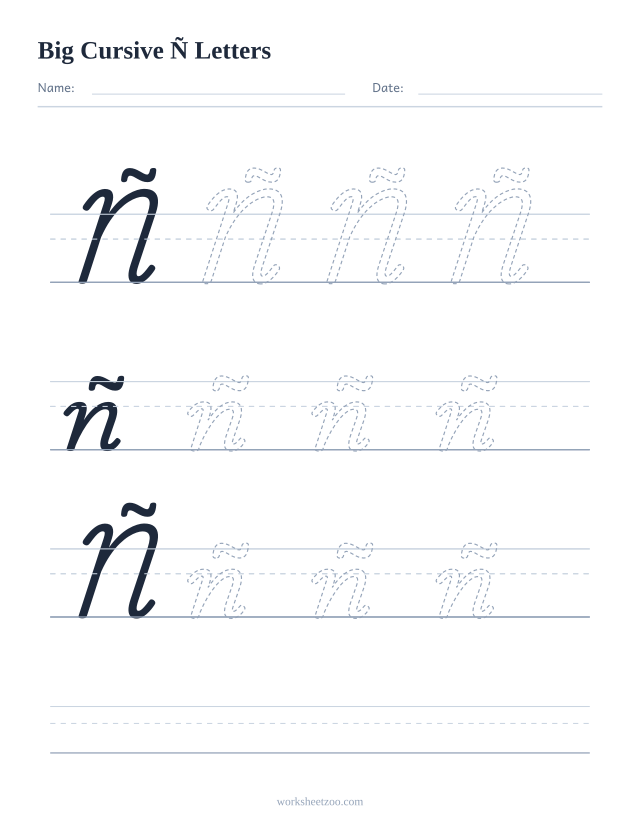
Big Cursive Ñ
Extra-large cursive eñe: trace the capital and small letter and its tilde slowly, with room to spare.
Download PDF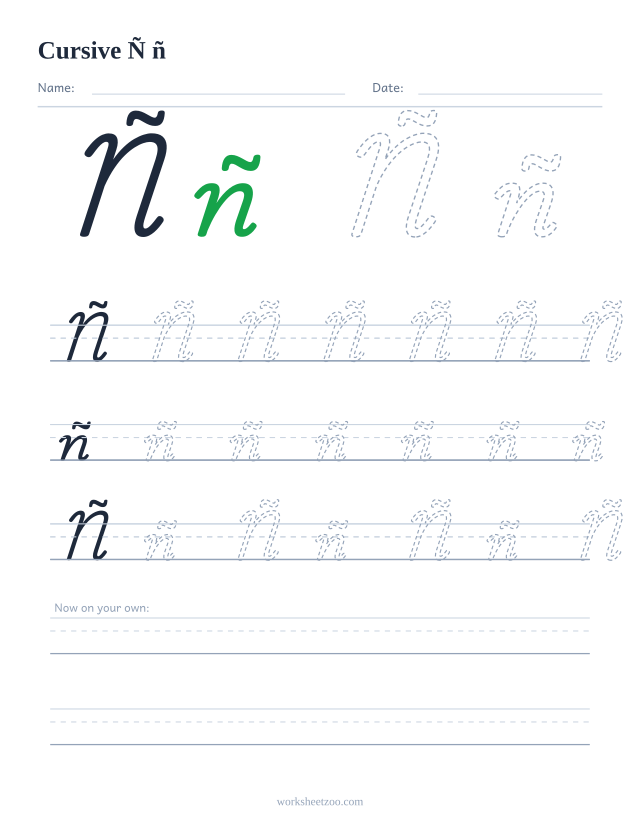
Cursive Ñ & ñ
The Spanish letter eñe, capital and small, side by side on handwriting guides.
Download PDF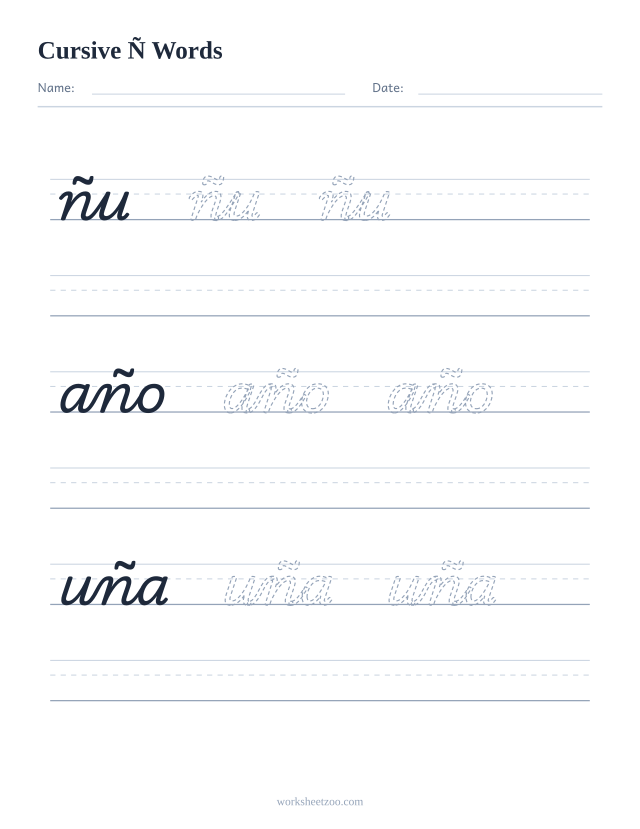
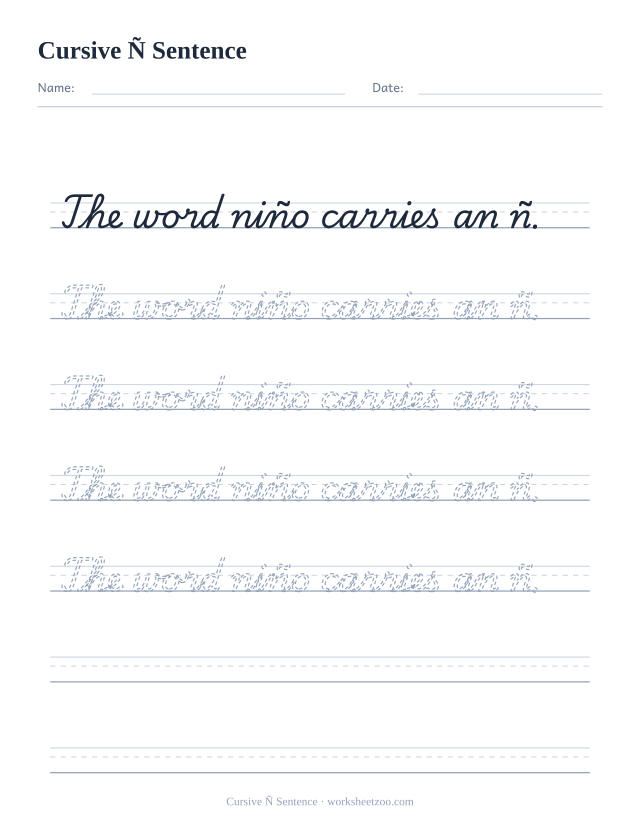
Cursive Ñ Sentence
A whole sentence to trace and then copy: The word niño carries an ñ. Joining letters inside real words is the step single letters cannot teach.
Download PDFThe letter ñ is the fifteenth letter of the Spanish alphabet and it exists in no other major European language. In cursive it is written exactly like n, two downstrokes joined by a rounded arch, and then the tilde is added above it as a separate wavy stroke once the word is finished. The letter body is not modified in any way.
The tilde is a delayed stroke
Like the dot on i and the bar on t, the tilde on ñ goes on after the word is complete, in a single tidy up pass. It should sit centred above the letter, span roughly the width of the n beneath it, and wave rather than run flat, because a straight tilde starts to look like a macron or like a crossing stroke that belongs to something else.
Why the letter exists
The tilde began as a scribal shorthand: medieval Spanish copyists wrote a small n above the line to mark a doubled nn, and over centuries that abbreviation became a letter in its own right. That is why ñ appears in words descended from Latin double n, such as año from annus. Knowing this makes the wave above the letter feel less arbitrary to a child learning it.
What the Ñ worksheets contain
The extra large page prints Ñ and ñ big enough that the tilde has to be placed deliberately rather than flicked, with a solid model in front of three dashed copies on each band. The guided page shows capital and lowercase together at 96 point, then rows of seven of each and four Ññ pairs on three line guides, ending with two ruled lines. The words page traces ñu, año and uña, three genuine Spanish words.
Where does the tilde on ñ go?
Centred directly above the body of the letter, added after the word is written, and about as wide as the n underneath. It should be a wave with a visible rise and fall, not a straight bar. In Spanish schools it is taught in the same lesson as the i dot and the t bar, because all three are strokes that wait until the word is done.