
Cursive Letter C Worksheets
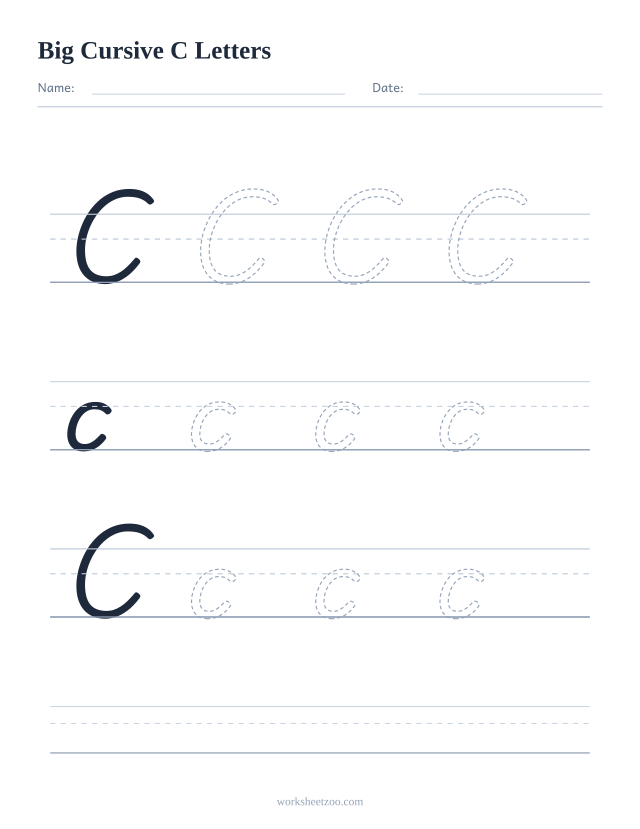
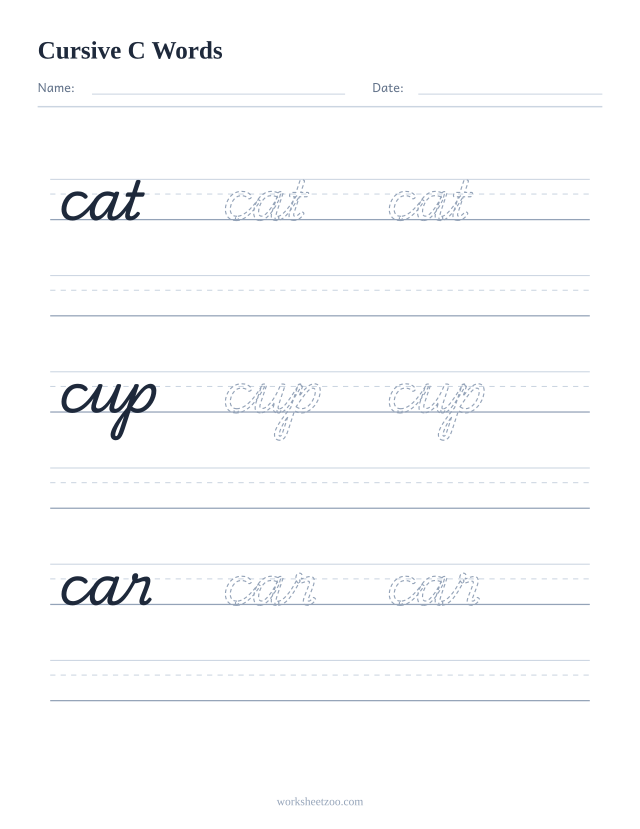
Cursive c is one open curve and no loop, which makes it the letter to use when a practice session needs to end well. Work through the oversized c, the capital beside it, then cat, cup and car.
Curated by  Poppy Fox
Cursive C Sentence
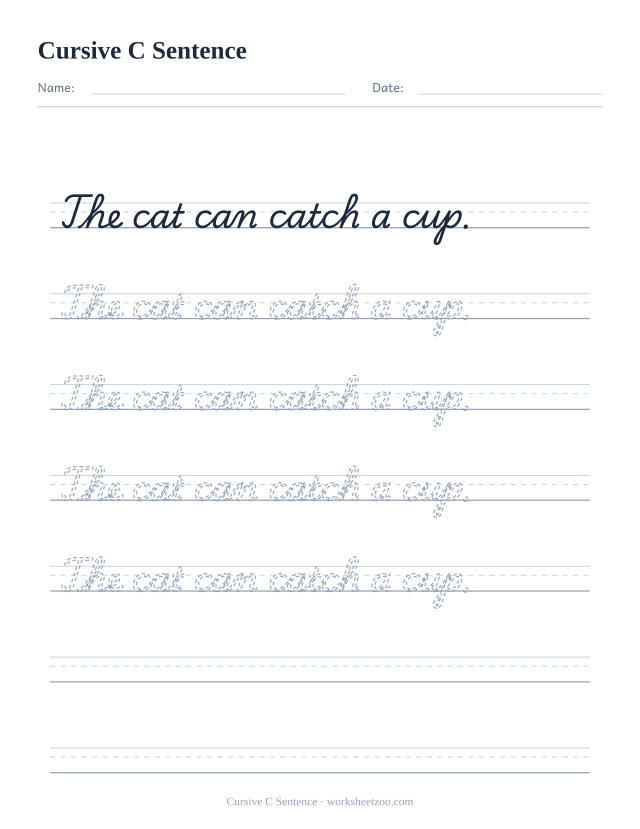
A whole sentence to trace and then copy: The cat can catch a cup. Joining letters inside real words is the step single letters cannot teach.
Download PDFCursive c is a single open curve and it is the letter to reach for when a practice session needs an easy win. Start below the midline, curve up and left as if you were beginning an a, come around the bowl, and then stop instead of closing it. The pen leaves the letter at the baseline with a normal undercurve, so c joins forwards to anything without complication.
Almost an a, deliberately unfinished
The entry stroke of c is exactly the entry stroke of a, d, g, o and q. That shared opening is why teachers often show these six letters together: learn the over and around motion once and six letters follow. The difference is only in what happens next. c stops after the curve, a and d and g and q close the oval and then choose a different tail, and o closes and exits high.
The mistake is closing it
A c that closes at the top has become an o, and words like cat and cup stop being readable. If a child keeps closing it, have them lift the pen deliberately at the end of the curve for a few repetitions, then reintroduce the exit stroke. The opposite fault, a c so open it looks like a comma, is rarer and usually fixes itself as speed increases.
What is printed on the sheets
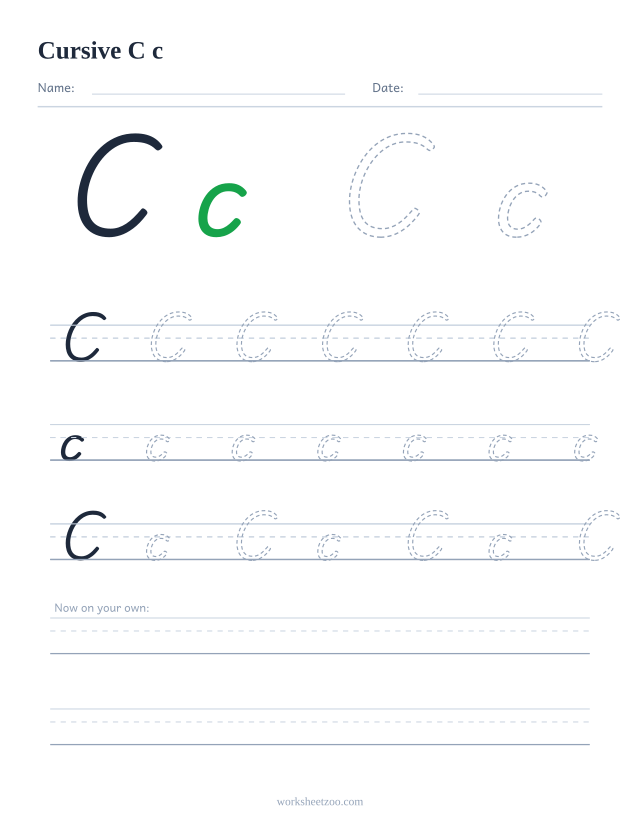
Three free PDFs sit above this text. The big letter page carries C and c at 88 point with generous spacing so the curve can be swept with the arm. The guided page shows the pair large, then runs rows of seven capitals, seven lowercase and four Cc pairs, and closes with two ruled lines for unaided writing. The words page traces cat, cup and car, each with a solid model, two dashed repeats and an empty row.
Is c a good first cursive letter?
It is one of the best after the simple upstroke letters. c is a single curve with no loop, no descender and an ordinary baseline exit, so it builds confidence quickly. Many teachers open with i, t, u and l for the undercurve, then use c to introduce the whole downcurve family that follows it.