
Cursive Letter Q Worksheets
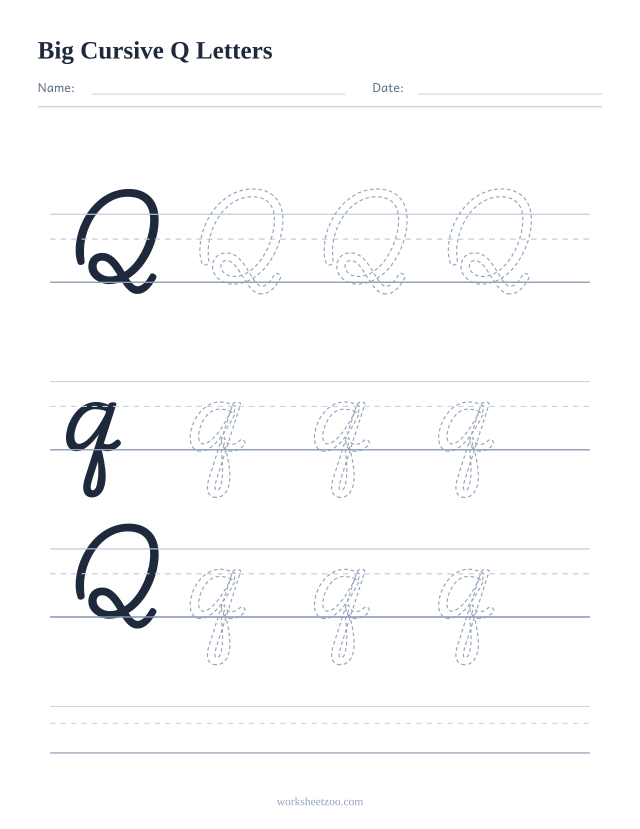
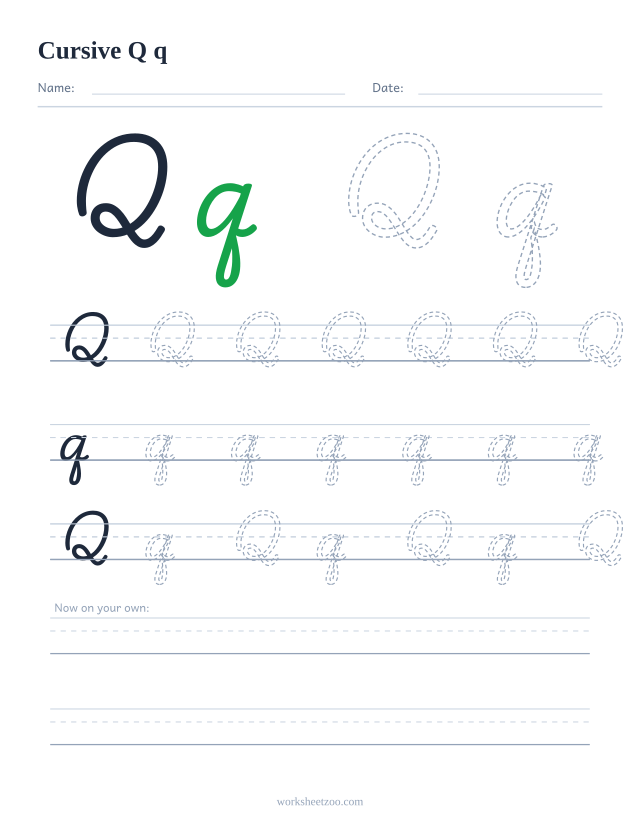
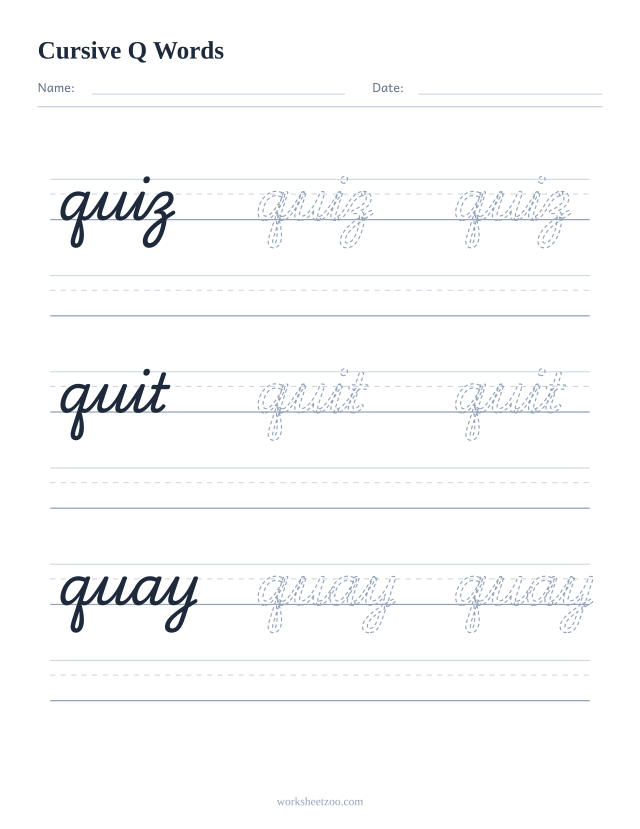
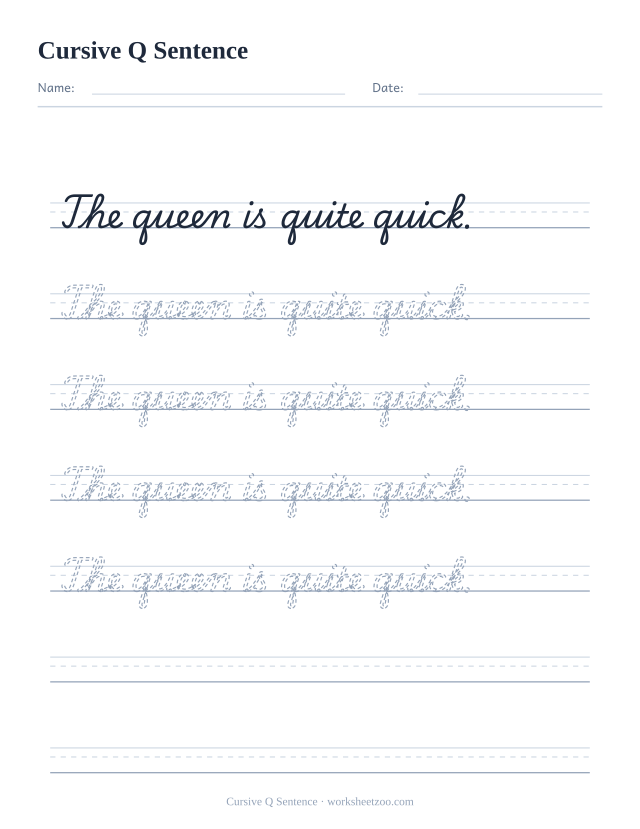
Cursive q is g with the bottom loop turned the other way, and that is the entire difference. Worth pairing with the g page. Big letter, pair, quiz, quit and quay, one sentence.
Curated by  Poppy Fox
Cursive Q Sentence
A whole sentence to trace and then copy: The queen is quite quick. Joining letters inside real words is the step single letters cannot teach.
Download PDFCursive q is the mirror image of cursive g, and that is the whole letter. Open with the same downcurve, close the oval at the top, retrace down the right side and continue straight through the baseline into the descender space, then loop to the RIGHT and bring the stroke back up to the baseline to join the next letter. Everything except the direction of that final loop is shared with g.
Right loop for q, left loop for g
These two letters are the classic confusion in joined handwriting, and the confusion is mechanical rather than conceptual: the hand is more comfortable swinging left, so the g motion tries to take over. The practical answer is to teach them weeks apart, drill q with its own row of repetitions, and only then write the pair side by side so the mirror can be seen deliberately rather than discovered by accident.
In English q never travels alone
Except in a handful of borrowed words, English q is always followed by u, so practising the letter in isolation is only half the job. Write qu as a unit from the start, then que, qui and quo, and the join becomes part of the letter in the child's hand. This is also why the words sheet on this page uses quiz, quit and quay: every one of them forces the qu pair.
What the three free sheets contain
The extra large page prints Q and q at 88 point so the direction of the descender loop is impossible to miss, with a solid model ahead of three dashed copies on every band. The guided page shows capital and lowercase together, then rows of seven capitals, seven lowercase and four Qq pairs on three line guides, and finishes with two ruled lines. The words page traces quiz, quit and quay.
Why does cursive Q look like a 2 in capitals?
Because traditional American school cursive draws the capital Q as a large oval with a tail that crosses back over itself, and the resulting shape reads as a handwritten figure 2 to anyone who did not learn it. It is the least recognised capital in the alphabet, alongside cursive X and Z, and it is the reason many adults print their Q instead.