Cursive Letter O Worksheets
Cursive o closes at the top and leaves from the top, so the join runs flat at midline height instead of rising from the baseline. The four sheets finish with owl, oak and odd, then a sentence to practice the join.
Curated by  Poppy Fox
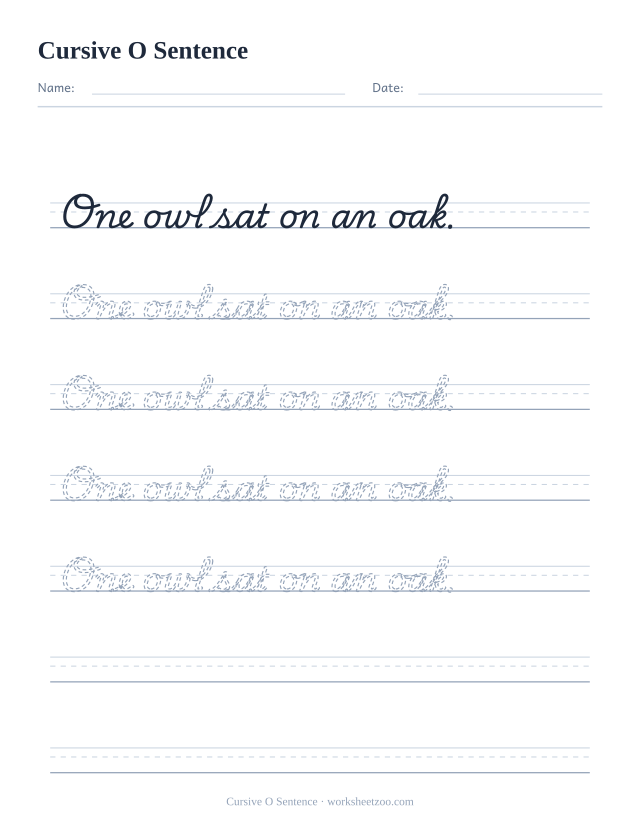
Cursive O Sentence
A whole sentence to trace and then copy: One owl sat on an oak. Joining letters inside real words is the step single letters cannot teach.
Download PDFCursive o is a closed oval that leaves from the top. Start below the midline, curve up and to the left, take the oval all the way around, close it at the top, and then exit with a short flat stroke that runs to the right at midline height. That high exit is unusual and it is the reason o causes more join problems than any other letter in the lowercase alphabet.
The oo, ow and on joins
Because o hands the stroke over at the midline rather than the baseline, everything that follows it enters from above. oo, ow, on, ot and ou all look wrong when a child joins them at the baseline out of habit, and the fault is invisible in single letter practice. Write the pairs deliberately: oo first, then ow, then oa, and the awkwardness clears up in a few lines.
An unclosed o is an unreadable word
The other frequent fault is leaving a gap at the top, which turns o into c or into a lowercase u depending on how the exit lands. Words like oak and owl then stop working. On the guided sheet, look at the top of each o rather than at its overall roundness, because the closure is the part that carries the meaning.
What the three free PDFs contain
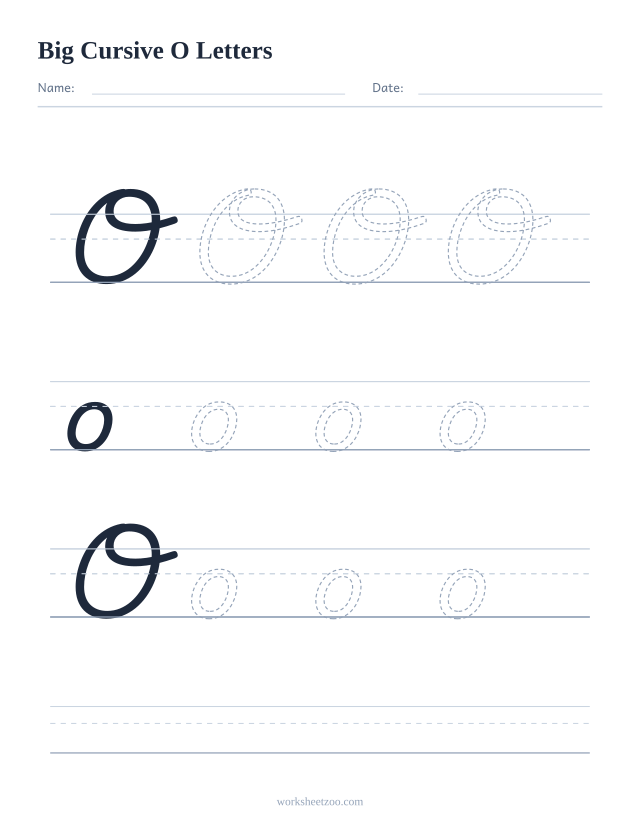
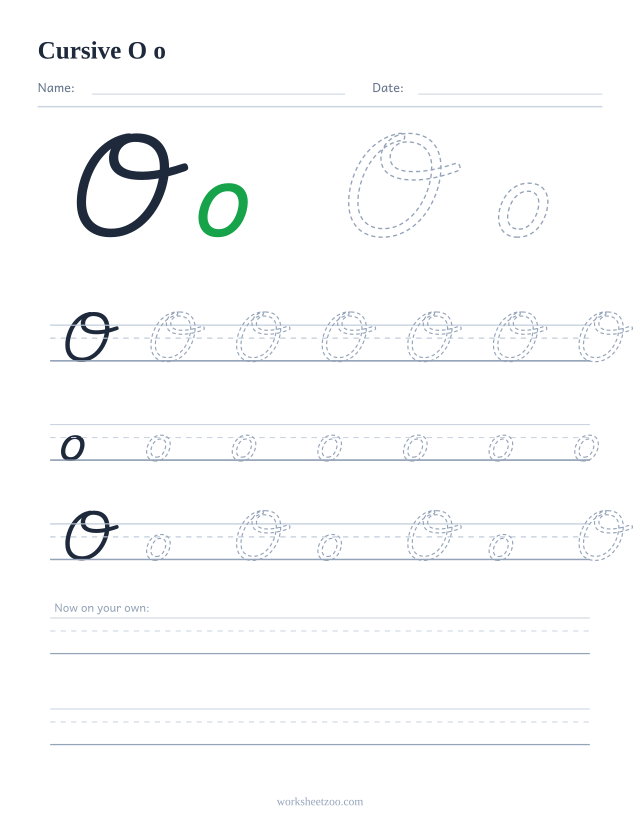
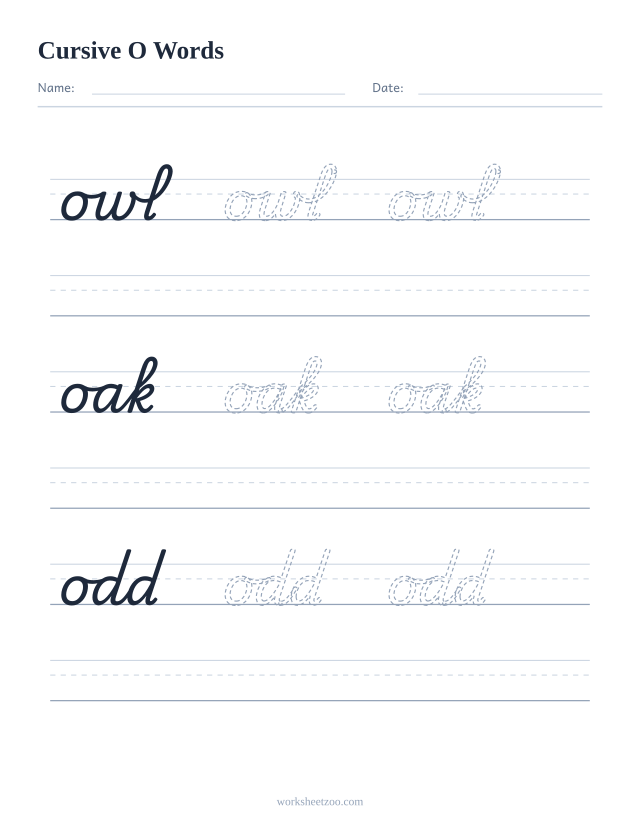
The extra large sheet prints O and o at a size where the top exit stroke is clearly separate from the oval, with a solid model ahead of three dashed copies on each band. The guided page shows capital and lowercase together, then rows of seven capitals, seven lowercase and four Oo pairs, ending with two ruled lines. The words page traces owl, oak and odd, each with a blank ruled row beneath.
Why does oo look wrong when children write it?
Because both o letters exit at the midline, so the join between them is a flat bridge rather than the usual sweep up from the baseline. A child who connects at the baseline produces a wide loop between the two letters that reads as oa or as a. Practising oo, ow and oo on its own line fixes it faster than practising o alone.