
Cursive Letter U Worksheets
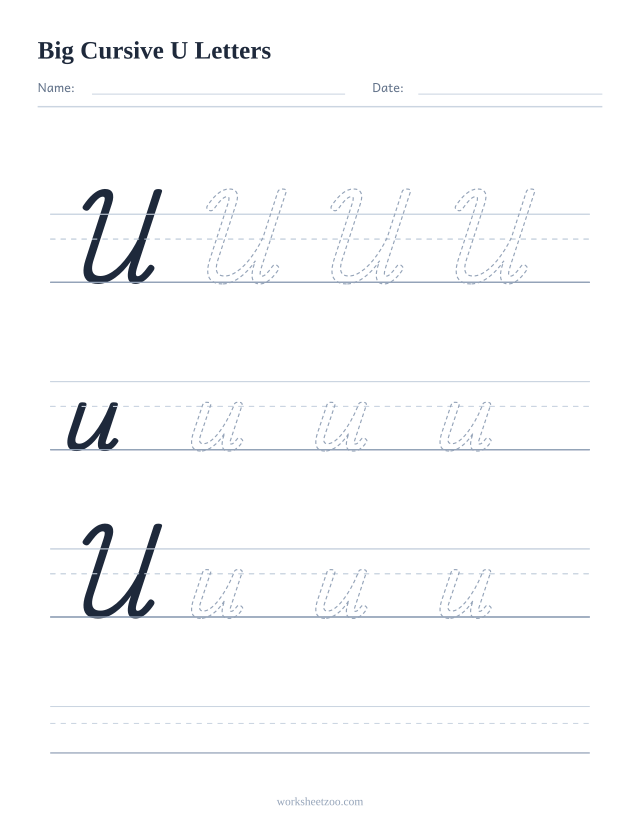
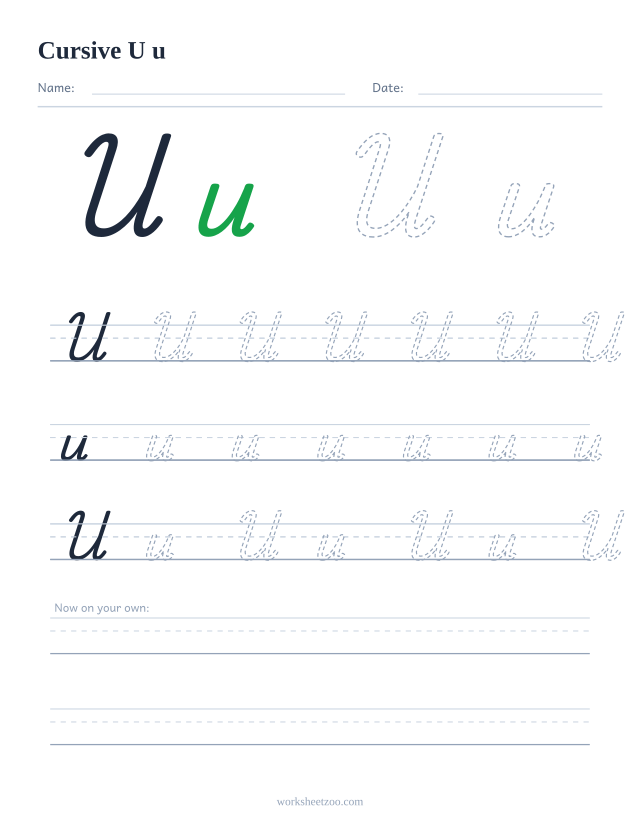
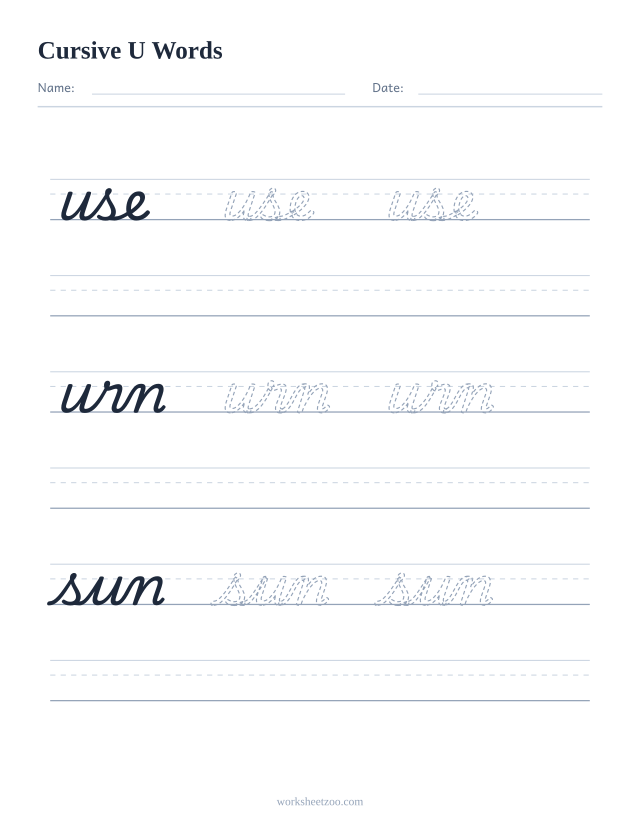
Cursive u is two valleys in a row, and it turns into a w the moment a third one appears. Big model, the capital beside it, then use, urn and sun, then the sentence.
Curated by  Poppy Fox
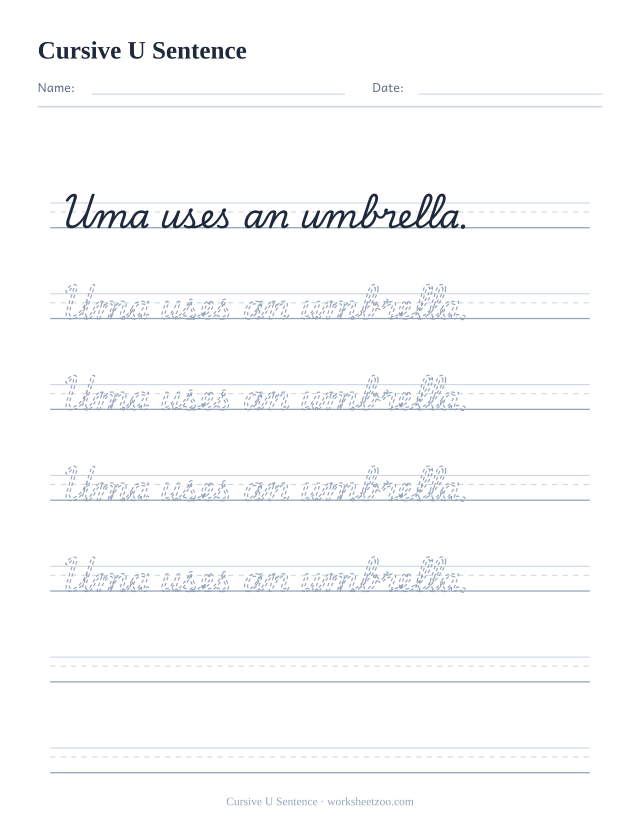
Cursive U Sentence
A whole sentence to trace and then copy: Uma uses an umbrella. Joining letters inside real words is the step single letters cannot teach.
Download PDFCursive u is two valleys in a row. Run the undercurve up from the baseline to the midline, come down to the baseline, curve up to the midline again, come down a second time and exit forward. Every turn is at the bottom, which is what makes u the simplest of the double stroke letters and a natural early lesson.
The opposite motion to n
n arches over the top; u dips under the bottom. Learning them close together is efficient but it is also the source of the most common early confusion, so many teachers introduce u first, while the undercurve is still the only motion the hand knows, and hold n back until the arch can be taught as a genuinely new movement. Either order works as long as the contrast is made explicit.
Keep the second valley the same width as the first
Because u is symmetrical, any unevenness shows immediately. A second valley that is narrower than the first makes the letter lean forward, and on a full line of writing the whole word slants. This is a good letter for the check your own work habit: compare the last u on a practice row against the printed model at the start of the same row.
What the sheets give you
The extra large page carries U and u at 88 point, a solid model ahead of three dashed copies on each band, with a free ruled band at the foot of the page. The guided page shows capital and lowercase together, then rows of seven capitals, seven lowercase and four Uu pairs on three line guides, ending with two empty lines. The words page traces use, urn and sun.
Is u easier to learn than n?
Usually yes, because u only repeats the undercurve the hand has already learned from i, t and l, while n introduces a new arching motion over the top. Many cursive sequences therefore teach i, t, u and l first as a block, then bring in n and m as the second group.