
Cursive Letter V Worksheets
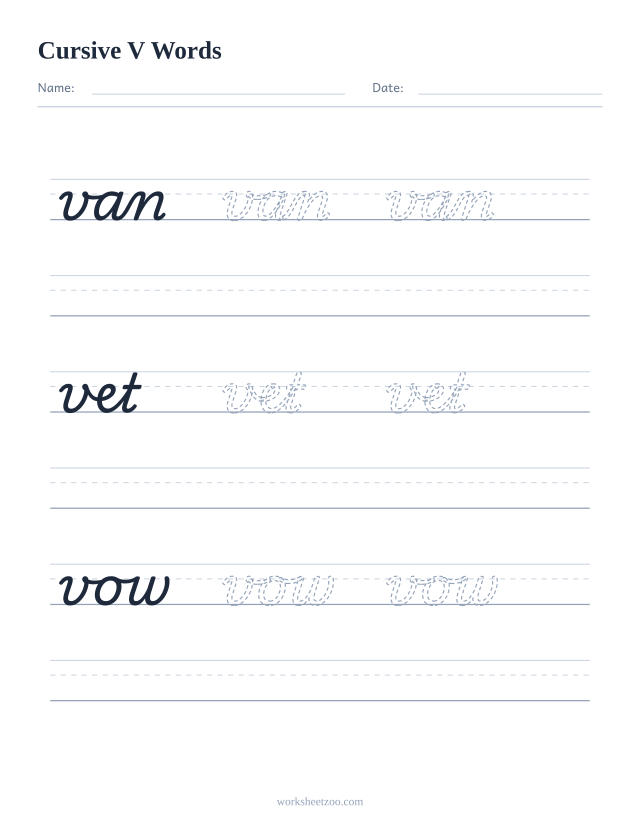
Cursive v finishes high with a flat checkstroke, which is why vowel joins after v look wrong when the letter is ended at the baseline. The set ends on van, vet and vow, then a line to write out in full.
Curated by  Poppy Fox
Cursive V Sentence
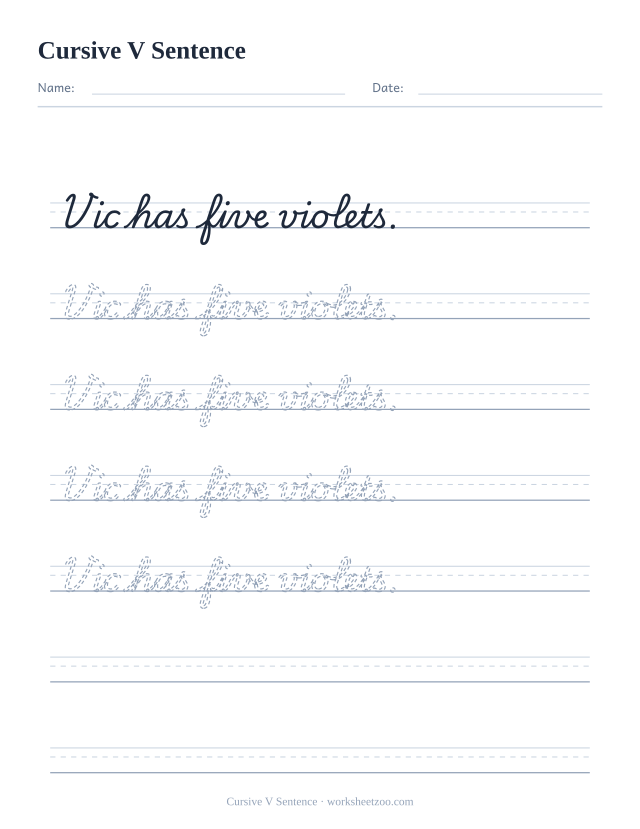
A whole sentence to trace and then copy: Vic has five violets. Joining letters inside real words is the step single letters cannot teach.
Download PDFCursive v is a single rounded valley that finishes high. Enter with an overcurve from the baseline, come down to the baseline in one stroke, curve back up to the midline and stop there with a short flat checkstroke pointing right. The bottom is rounded rather than the sharp point of printed v, and the exit at the midline is what gives the letter its character.
v hands over from the top
Like b, o and w, cursive v ends at the midline instead of the baseline, so the next letter has to be entered from above. That makes ve, vi and vo the joins worth practising: a child who connects at the baseline produces a loop between the letters that looks like a stray e. Writing the pairs on their own line for a few minutes is far more useful than repeating v alone.
Round the bottom, not the top
The frequent fault is importing the sharp angle of printed v. Cursive v turns smoothly at the baseline, and a pointed bottom makes it collide visually with cursive r and with the pointed base of s. The other thing to watch is width: v is narrower than u, because it has one valley instead of two, and children who have just learned u often make it too wide.
What the three PDFs contain
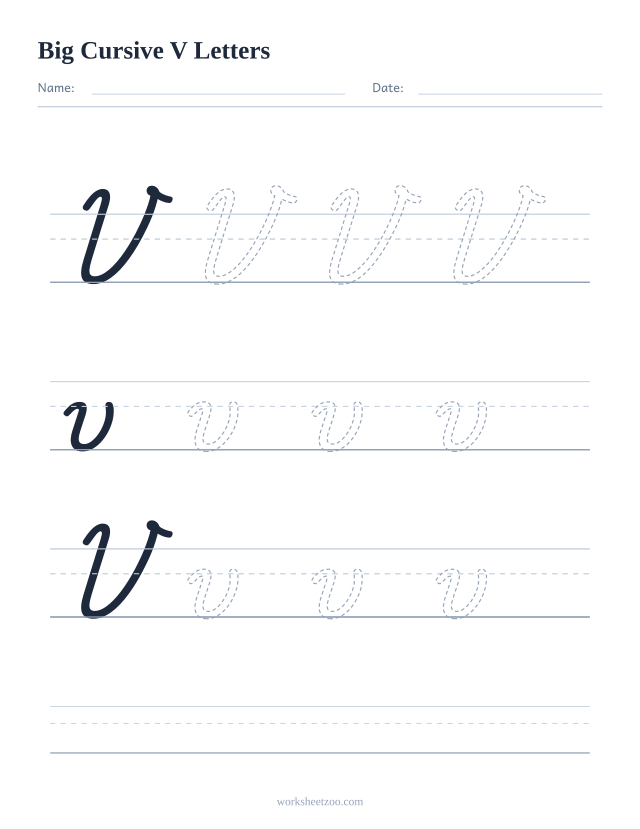
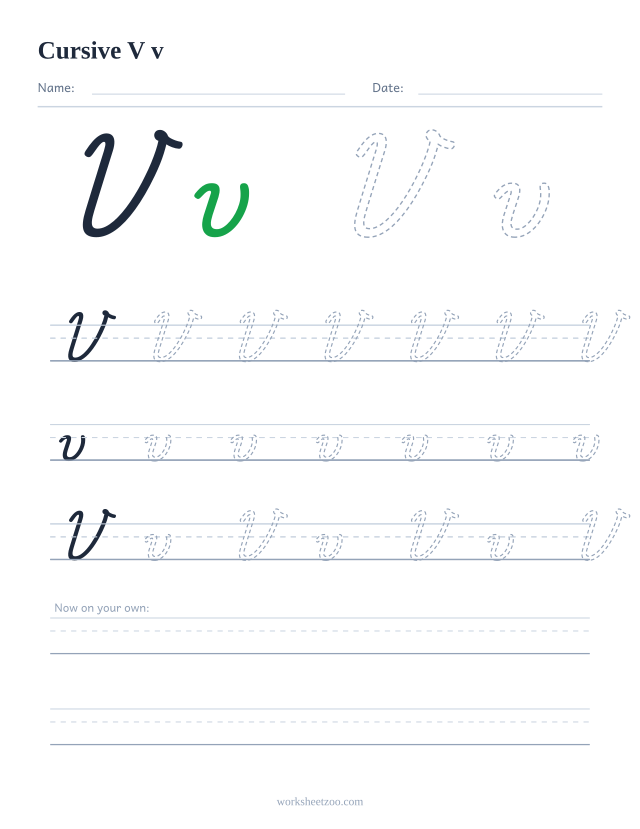
The extra large page prints V and v at a size where the midline checkstroke is clearly separate from the valley, with a solid model followed by three dashed copies on each band. The guided page shows the pair at 96 point, then rows of seven capitals, seven lowercase and four Vv pairs on three line guides, closing with two ruled lines. The words page traces van, vet and vow.
Which letters follow v badly?
Any letter that a child tries to enter from the baseline. Because v exits at the midline, the joins ve, vi, va and vo need a flat bridge across the top rather than a sweep up from below. The same applies after b, o and w, which is why those four letters are worth practising as a group once each is individually secure.