Cursive Letter G Worksheets
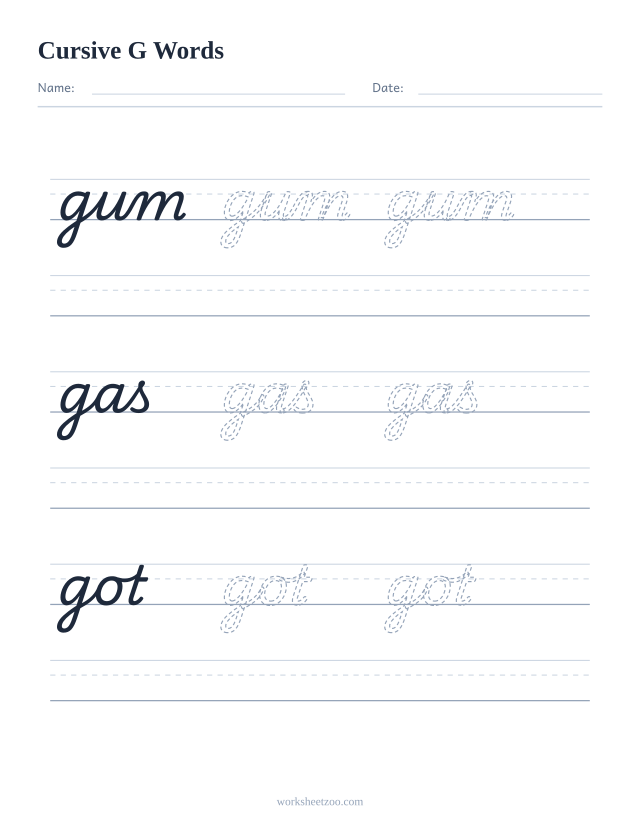
Cursive g loops to the left below the line, which is the opposite of what most children guess. The four pages end with gum, gas and got, then a sentence that uses them.
Curated by  Poppy Fox
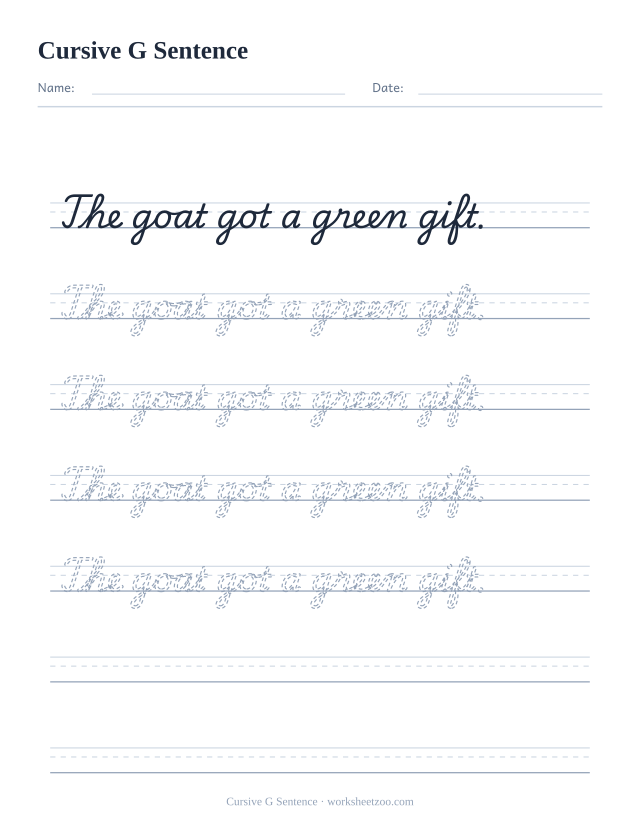
Cursive G Sentence
A whole sentence to trace and then copy: The goat got a green gift. Joining letters inside real words is the step single letters cannot teach.
Download PDFCursive g is an oval with a tail that goes the wrong way round, at least compared with what most people expect. Open with the same downcurve as a, close the oval at the top, retrace down the right side and keep going straight through the baseline into the descender space, then loop to the LEFT and bring the stroke back up to the baseline, where it exits toward the next letter. The direction of that loop is the entire letter.
Loop left, or you have written q
g and q are the same oval with mirrored tails: g loops left, q loops right. Nothing else distinguishes them, which is why the two are the classic mix up in joined handwriting and why teachers separate them by several weeks. If a child is producing q shaped g letters, write the pair side by side once and let them see the mirror, then drill g alone until the leftward swing is automatic.
The descender needs room
g belongs to the group that drops below the baseline: g, j, p, q, y, z and f. On lined paper with no descender space these letters collide with the line beneath, and children compensate by shortening the tail until it disappears. The three line guides on these worksheets leave the descender zone open on purpose, so the loop can reach its proper depth of roughly half a letter height.
What the sheets contain
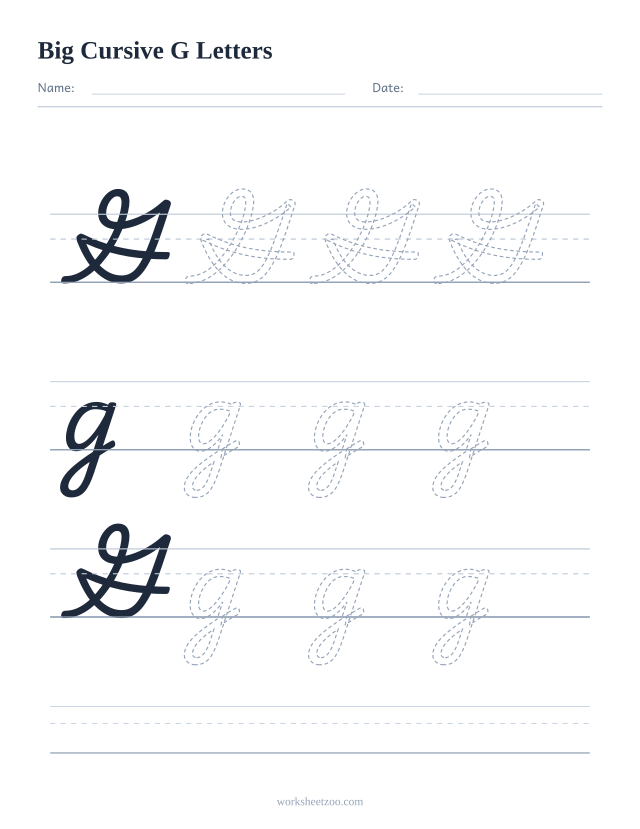
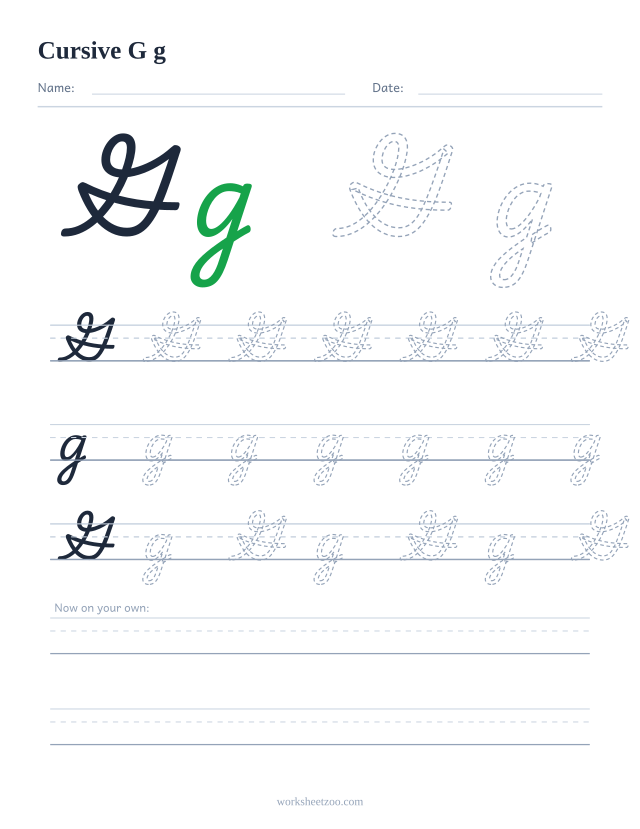
The big letter page prints G and g at 88 point with three dashed copies chasing each solid model, which gives the descender loop enough space to be drawn rather than scribbled. The guided page shows the pair large, then rows of seven capitals, seven lowercase and four Gg pairs, then two ruled lines. The words page traces gum, gas and got, each with a free ruled row underneath.
How is cursive g different from cursive q?
Only in the tail. Both start as a closed oval and drop a straight stroke below the baseline. Cursive g swings its loop to the left and comes back up on the right to join the next letter. Cursive q swings its loop to the right instead. Capital G and capital Q look nothing alike, so the confusion is a lowercase problem.