Cursive Letter S Worksheets
Cursive s closes against the baseline with a small point, not a curve, which is the detail that gets lost. Four sheets, closing with sun, six and sea and a sentence that strings them together.
Curated by  Poppy Fox
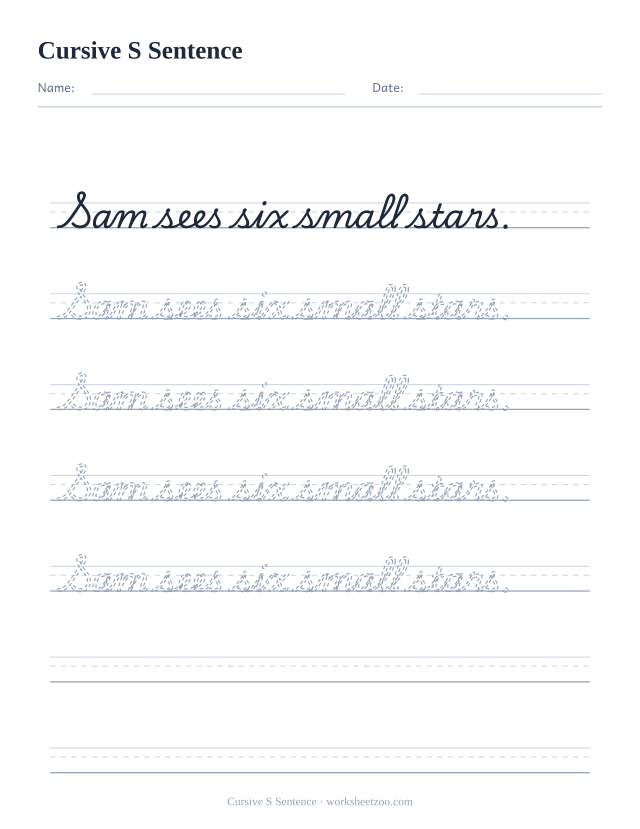
Cursive S Sentence
A whole sentence to trace and then copy: Sam sees six small stars. Joining letters inside real words is the step single letters cannot teach.
Download PDFCursive s is a small sail. Run the undercurve up from the baseline to the midline, curve back to the left and down, and close the shape against the baseline with a small point before exiting forward. The left side of the letter is a curve, the right side is nearly straight, and the bottom comes to a definite point rather than a rounded turn.
The point at the bottom is the letter
An s that rounds off at the baseline instead of pointing reads as an i or as an r, and because s is so common in English the effect on a page of writing is dramatic. The other half of the problem is the opposite fault, a bottom that is closed too tightly and fills with ink. Aim for a visible small triangle of white inside the base of every s.
Nothing like the printed s
s belongs with r and z in the group whose cursive shape a child cannot deduce from the printed letter. Printed s is a double curve; cursive s is a sail with a pointed foot. Say so plainly, show the two side by side once, and then practise only the cursive form. Trying to reason from the printed shape is what produces the wobbly hybrid s that many self taught writers end up with.
What the free sheets contain
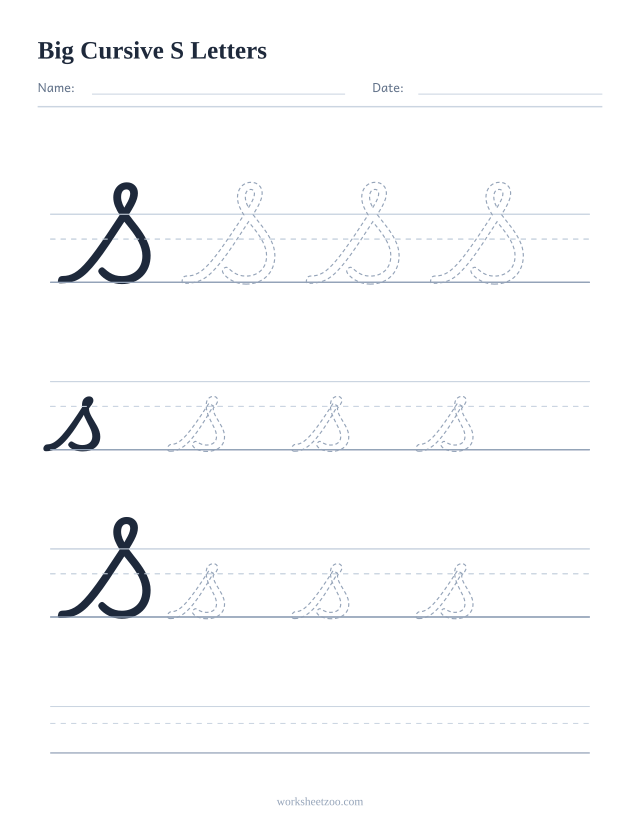
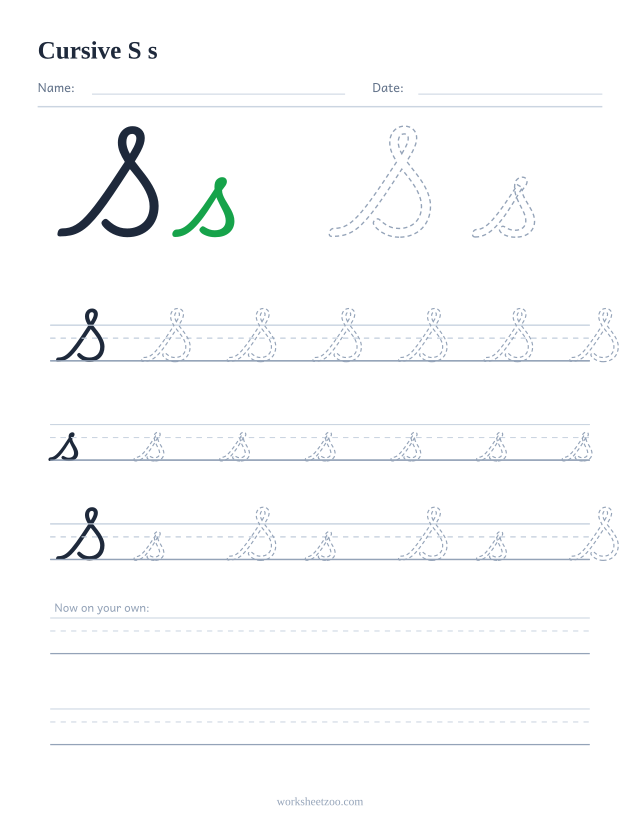
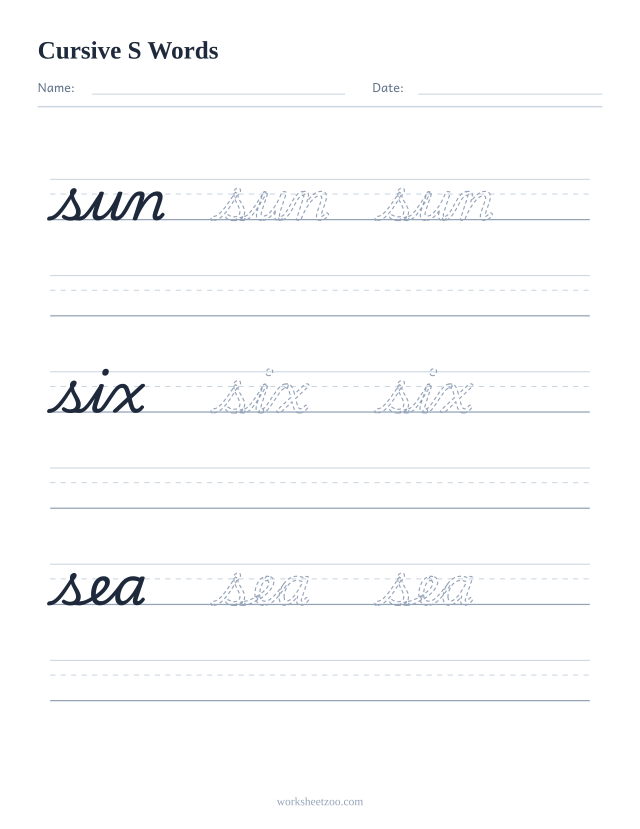
The extra large page prints S and s at 88 point, where the pointed base is large enough to control, with a solid model in front of three dashed copies on each band. The guided page pairs capital and lowercase, then runs rows of seven capitals, seven lowercase and four Ss pairs on three line guides, ending with two empty ruled lines. The words page traces sun, six and sea.
Why does cursive s have a point at the bottom?
Because the stroke has to reverse direction at the baseline in order to head back up into the next letter. The pen comes down the left curve, turns sharply and rises on the right, and that sharp turn is what produces the point. A rounded base means the pen has looped instead of turning, and the letter loses its identity.